
What Is a 3D Virtual Mall? Shopping in Your Browser, No App
A 3D virtual mall is a shopping centre you walk through as an avatar, right in your browser on a laptop or phone — no VR headset and no app to install. The browser draws the 3D world itself. In Aderlo City you sign in with your Aderlo account, walk the galleries with other visitors and order real products as you would online.

Key takeaways
- A 3D virtual mall needs only an up-to-date browser on a computer or phone — no headset, no download.
- Browsers draw 3D through the WebGL 2.0 standard, which Can I Use puts at about 97% of browsers in use worldwide.
- Buying in a 3D mall is a normal online purchase: in the UK you usually have 14 days to cancel after the goods arrive.
- The Aderlo City MVP has two galleries open: London on the Thames and Warsaw, with a premium showroom.
- A 3D mall will not beat a search box for a known item — it shines for browsing, gift hunting and shopping with friends.
For years “3D shopping” meant a VR headset, a heavy download and a virtual world with more promises than shops. Today you can walk into a three-dimensional shopping centre from a link, in the browser you already use. I am writing as someone who builds one: since October 2026 the Aderlo City MVP has had two Aderlo Galleries open — one in London and one in Warsaw — and orders from the Warsaw gallery are fulfilled by the Aderlo shop.
This guide explains what a virtual mall is, how it works in a browser, what you need, what your rights are when you buy — and when a 3D mall is genuinely useful, rather than slower than an ordinary online shop.
What is a 3D virtual mall?
A 3D virtual mall is a three-dimensional shopping centre that opens like a web page. Instead of a product grid you see a concourse, shop windows and shop interiors, and you move around as an avatar.
The difference from an online shop is space. Products sit in shops rather than in a list. You walk up to a display, step into a showroom, take the escalator to the next floor. You browse the way you would in a real shopping centre and you buy the way you would online: product card, size, basket, checkout.
The difference from VR shopping is hardware. There is no headset, no controllers and nothing to install from an app store. The browser you already have does the work.
The wider idea — shopping where you step into the space of a shop instead of scrolling through it — is often called immersive commerce.
Can you shop in 3D in a browser without downloading anything?
Yes. Modern browsers draw 3D graphics on their own through the WebGL standard — no plug-ins, nothing to install. The same standard works on computers and phones.
WebGL is the interface a web page uses to talk to your device’s graphics chip. Its current version, WebGL 2.0, is specified by the Khronos Group, and according to Can I Use it is supported by about 97% of browsers in use worldwide (as of 17 October 2026). Full support arrived in Chrome 56, Firefox 51, Edge 79, and Safari 15 on both Mac and iPhone.
In practice you enter the mall from a link, just as you would an online shop. The first visit takes longer because the browser downloads the city — buildings, textures, characters. On later visits part of that is already cached.
WebGL’s successor is WebGPU, a newer interface that gives web pages fuller access to the graphics hardware. MDN notes, however, that WebGPU does not yet work in some of the most widely used browsers and only runs over a secure (HTTPS) connection. That is why virtual malls that need to work for everyone still rely mainly on WebGL 2.0 today.
How does a virtual mall work behind the scenes?
There are two approaches: your browser draws the world itself, or it receives a finished picture from a server. Most malls use the first and keep the second for spaces that need to look photographic.
Approach 1: graphics drawn on your device. The browser downloads a model of the mall and renders it live through WebGL. Movement feels instant because nothing waits for a server, and many people can share the same space cheaply. The limit is your phone or laptop: whoever builds the mall has to keep the number of objects and the texture quality within what ordinary hardware can handle.
Approach 2: a picture streamed from a server. The scene is rendered on a powerful server with a graphics card, and your browser receives a video stream — much like cloud gaming. Browsers can receive such streams without plug-ins thanks to WebRTC, the technology for sending audio and video in real time. The upside is near-photographic quality even on a modest phone. The downsides are a server cost per viewer and the need for a steady connection.
| Drawn in the browser | Streamed from a server | |
|---|---|---|
| Who renders the graphics | your device (WebGL) | a server with a graphics card |
| Image quality | good, depends on the device | close to a photograph |
| Response to movement | instant | slight network delay |
| Connection needs | heavy on first visit, light afterwards | constant while you watch |
| Many visitors at once | yes, cheaply | yes, but each gets their own stream |
| Best for | concourses, floors, many shops | premium showrooms, single-brand displays |
Aderlo City combines both. The galleries — squares, concourses, floors and shops — are drawn by your browser. The premium showroom on the third floor of the Warsaw gallery is streamed in photorealistic quality straight from our servers. Moving between the two is simply walking through the showroom door.
What kinds of 3D shops are there?
“3D shop” covers several quite different things. It is worth telling them apart, because they promise different experiences and need different kit.
| Type | What you see | How you move | Buying |
|---|---|---|---|
| 3D product viewer on a product page | one product to rotate | spin it with a finger or mouse | the shop’s normal basket |
| 360° virtual tour | spherical photos of a real shop | jump between fixed points | usually links out to the online shop |
| Brand virtual showroom | one space for one brand | freely or along a path | anything from catalogue to basket |
| 3D virtual mall | many shops, floors, other people | freely, as an avatar | product cards and basket in the mall |
| VR headset store | a space all around you | head movement and controllers | depends on the app |
A 3D virtual mall is the closest to a real shopping centre: many shops in one place, other shoppers around you, and the freedom to wander from one unit to the next without going back to a search page.
How is a 3D mall different from an online shop and from VR?
A 3D mall borrows the sense of place from VR and the convenience of an online shop. The table sums up the trade-offs.
| Feature | Online shop | 3D mall in the browser | VR shop |
|---|---|---|---|
| What you need | a browser | a browser (computer or phone) | a VR headset and an app |
| Installation | no | no | usually yes |
| How you see products | photos and a description in a list | in the shop space, with a product card | in 3D space, in the headset |
| Other shoppers | invisible | you walk around together | depends on the app |
| Finding a specific item | fastest (search, filters) | slower — you walk and look | slower |
| Order and delivery | in the shop | with Aderlo — same account and basket | depends on the shop |
The table is also honest about the weak spot. If you know exactly what you want, a search box will beat a stroll every time. A mall wins where looking, comparing things in space and company matter.
Can I shop with friends in a virtual mall?
Yes — that is one of the main reasons to use one. In the Aderlo Gallery you walk around together with other visitors, each as their own avatar, in the same shops at the same time.
This is the part an online shop cannot copy. Sending a friend a link to a product page is not the same as walking past the same windows together, stopping at the same display and deciding on the spot. For long-distance families, gift shopping for someone else or simply browsing with a friend in another city, a shared 3D space feels much closer to a Saturday at the shops than a group chat full of links.
Two practical tips: agree on a meeting point first (the square in front of the gallery works well), and keep a call or messaging app open alongside if you want to talk while you browse.
How does buying in the Aderlo Gallery work?
You open a link, sign in with your Aderlo account, pick a country on the map and walk the gallery. You buy from a product card, and Aderlo handles the order.
- Open mvp.aderlo.city on a computer or phone.
- Sign in with your Aderlo account. If you do not have one yet, you can create it at aderlo.pl.
- Choose an avatar.
- Pick a country on the map of Europe. After a short flight over the city you land on the square in front of the gallery.
- Go inside and explore: the concourse and fountain, escalators, the glass lift, the upper floors and the roof garden.
- Walk up to a shop window or a mannequin and open the product card: photo, description, price, size.
- Add it to your basket and place the order. Aderlo handles delivery, just as with an order from its online shop.

MVP screenshot: the map of Europe where you choose a country. Poland and the United Kingdom, home to the two Aderlo Galleries, are highlighted.
The London gallery stands on the Thames, with Tower Bridge and Big Ben in view. You can already walk around it with other visitors; its shops open together with aderlo.co.uk. The Warsaw gallery already sells real Aderlo products. On its ground floor, next to the escalators, there is the Smarting HOME showroom for home energy and smart-home kit. On the third floor there is the premium showroom with mannequins and clothing rails — you walk up to a mannequin, open the product card, pick a size and add the item to your basket.
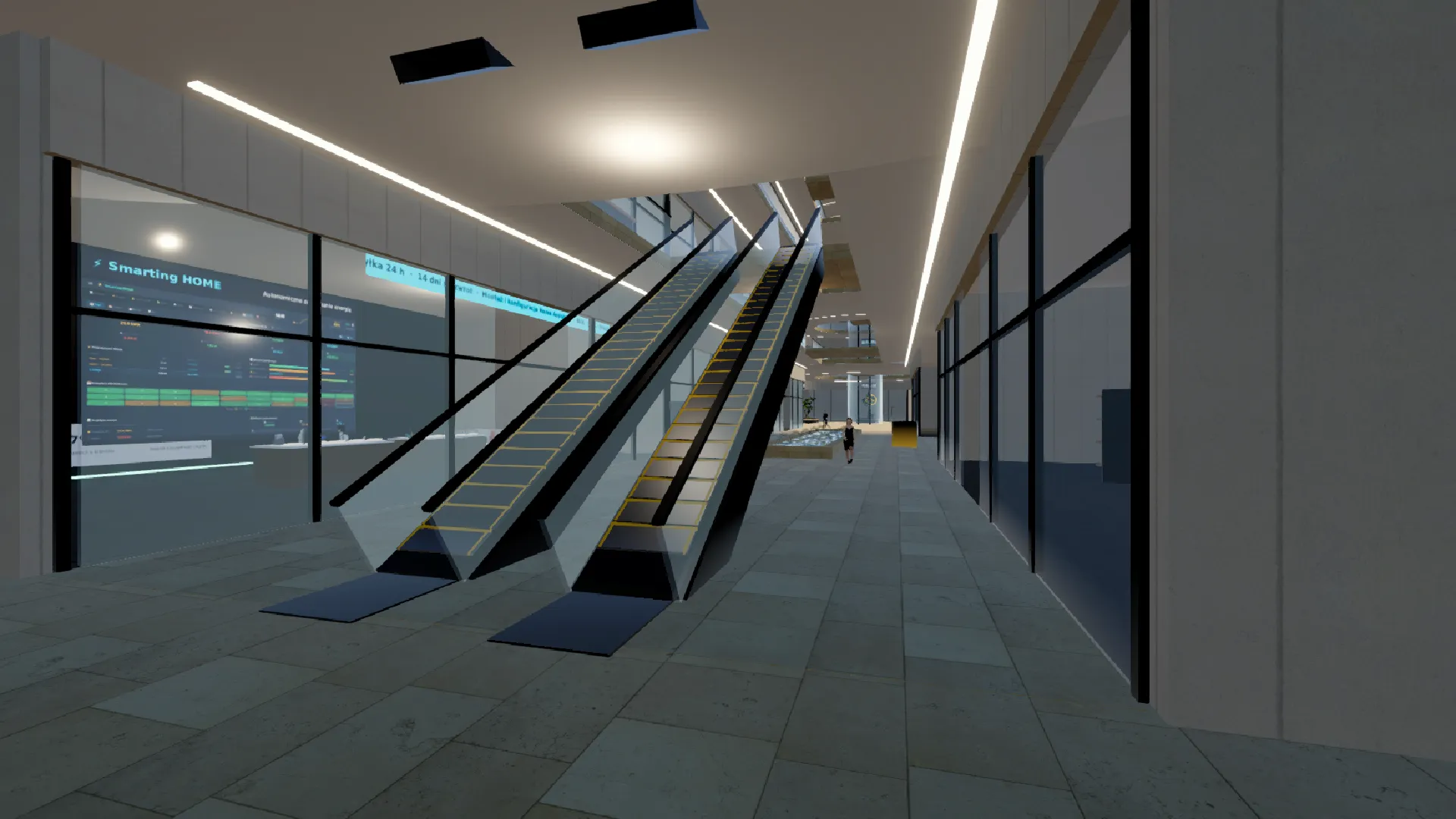
MVP screenshot: escalators on the ground floor of the Aderlo Gallery in Warsaw, with the Smarting HOME shop window on the left.
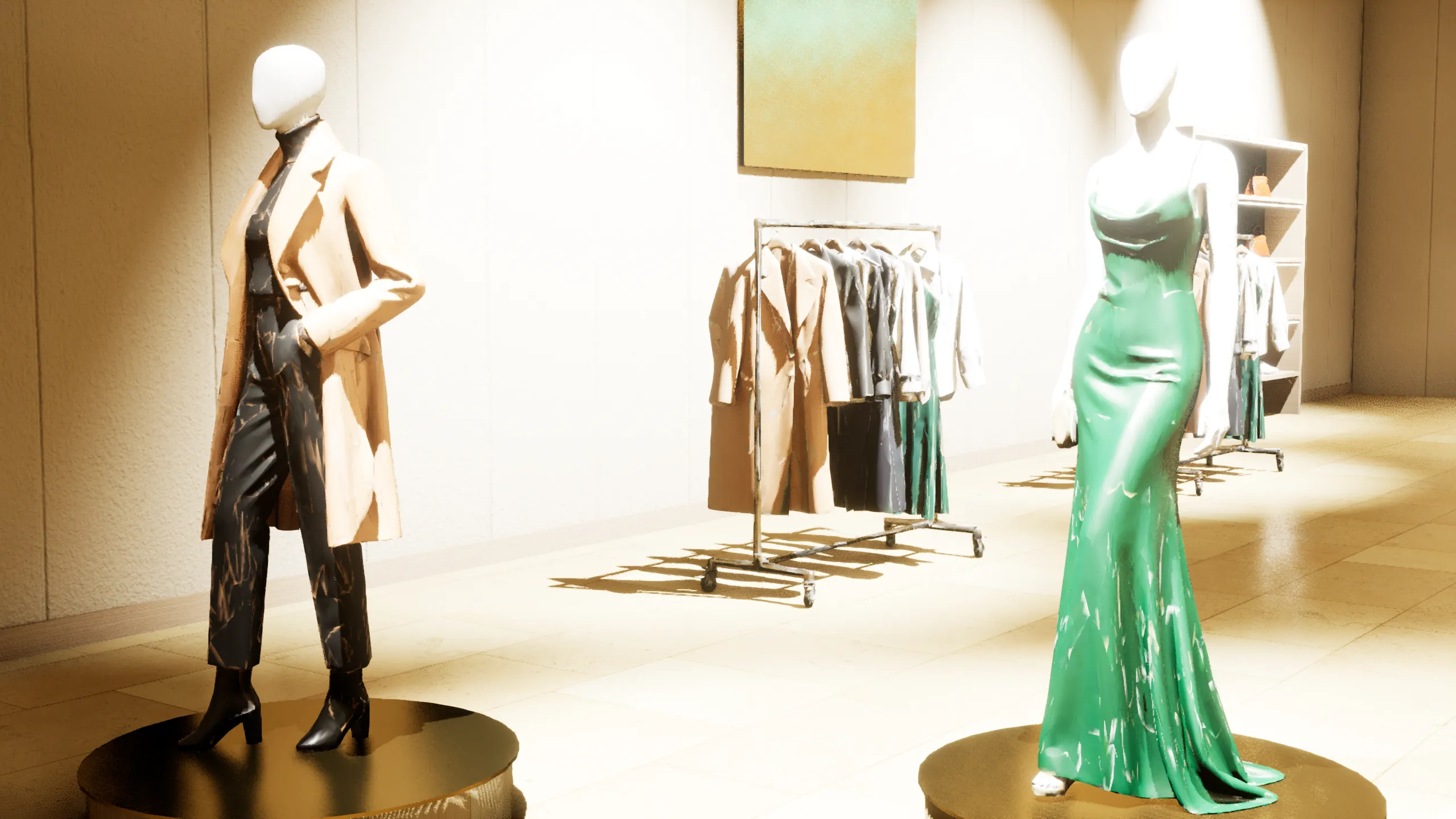
MVP screenshot: the premium showroom on the third floor, streamed in photorealistic quality from our servers.
One principle we build the gallery around: in a 3D space people explore first and buy second. So in every unit we keep the product card one click away from the display and show prices on the display itself. Without that, a stroll turns into sightseeing rather than shopping.
Are my consumer rights the same when I buy in a 3D mall?
Yes — a 3D mall purchase is a distance contract, just like any online order. In Great Britain these rules come from the Consumer Contracts (Information, Cancellation and Additional Charges) Regulations 2013.
The points that matter most:
- A 14-day cancellation period. Under regulation 30, for goods the period normally ends 14 days after the day the goods come into your physical possession (or that of someone you nominate, other than the courier).
- No reason needed. You can change your mind within that period. Citizens Advice publishes a template letter for cancelling goods bought online.
- A refund within 14 days. Under regulation 34, if the trader has not offered to collect the goods, the refund is due within 14 days of the day they receive the goods back or, if earlier, the day you supply evidence that you have sent them.
- Exceptions apply (regulation 28), for example to goods made to your specifications or clearly personalised, and to sealed goods that are unsuitable for return for health or hygiene reasons once unsealed.
This is a general summary, not legal advice for your situation. If something goes wrong, the Citizens Advice consumer service is the right first stop.
Online shopping is a large part of everyday spending in Britain: the Office for National Statistics put online sales at 28.8% of all retail sales in August 2026. Wherever you buy, the same checks apply. Before you pay in any 3D mall, find out who the seller is (company name and contact details in the terms), check the web address and that the connection is secure, and make sure the mall leads to a recognisable checkout rather than a bank transfer to a personal account.
Is a 3D virtual mall just the metaverse with a new name?
Not quite. After 2021 “the metaverse” came to mean VR headsets, cryptocurrencies and virtual land sold as NFTs. A browser-based 3D mall keeps only what actually works: a shared space and walking around as an avatar.
In Aderlo City:
- you do not need a headset or a crypto wallet,
- you pay for products in ordinary currency and receive a parcel,
- you sign in with your shop account, not a separate “metaverse account”,
- you buy real products, not virtual items or plots of land.
So if you are looking for metaverse shopping without a headset, it exists — but you will find it under “3D virtual mall” or “virtual shopping in the browser”. That is what the part that works is called today.
What device and connection do I need?
An ordinary laptop or phone with an up-to-date browser. You do not need a gaming PC, but a few settings make a real difference.
- An up-to-date browser. Current versions of Chrome, Edge, Firefox and Safari all support WebGL 2.0.
- Hardware acceleration on. If the mall feels unusually slow, check in your browser settings that it is allowed to use the graphics card.
- A steady connection for the first visit. That is when the browser downloads the most data, so on a phone it is best done over Wi-Fi.
- Laptop plugged in. On battery, many systems throttle graphics performance.
- Spare tabs closed. Every tab playing video or a game uses memory and graphics power.
We design the Aderlo galleries to run on everyday hardware: we limit how many objects are drawn at once, and the premium showroom — the most demanding space — is streamed from our servers. Its quality therefore does not depend on your phone.
When is a virtual mall worth it, and when is an online shop better?
A 3D mall is best for browsing and discovery; an online shop is best when you know what you want. Both lead to the same basket, so it comes down to the situation.
| Situation | Better choice | Why |
|---|---|---|
| You know the exact model you want | online shop | search and filters beat a stroll |
| You are hunting for a gift with no clear idea | 3D mall | you wander between shops and look at displays |
| You want a sense of the size of a larger item | 3D mall | it stands in a space next to other things |
| You are shopping with someone far away | 3D mall | you walk the same shops together |
| You are comparing technical specifications | online shop | a spec table is clearer than a shop window |
| Your connection is weak or you are short of time | online shop | a page loads faster than a 3D world |
How can I tell a good 3D mall from a gimmick?
A good 3D mall leads to a real checkout, works on a phone and needs no install. Run through this checklist before you invest your time.
- Opens from a link. It runs in the browser. If a site asks you to download a program or a plug-in, it is not a browser mall.
- A named seller. You know who fulfils the order and can confirm it in the terms: company name, address, contact details.
- Product cards with prices. Each product shows a price, sizes or variants and an add-to-basket button — not just a pretty model.
- Normal payment and delivery. You pay as you would in an online shop. A request for a bank transfer to a personal account or payment in crypto is a red flag.
- Works on a phone. You can get in from a smartphone, with controls designed for a touch screen.
- Clear returns policy. The terms cover cancellation and faulty goods just as an ordinary shop’s would.
- Honest labels. Screenshots of the working mall are clearly separated from visualisations of things still being built.
We take the last point literally: every image from the gallery is labelled “MVP screenshot”, and anything planned is labelled “Concept visualisation”.
What is open in Aderlo City today, and what is planned?
Two Aderlo Galleries are open — in London and in Warsaw. More districts and avatar try-on are planned, and we describe them as such.
In the MVP (October 2026):
- the map of Europe — choose a country, fly over the city and land on the square in front of the gallery,
- the Aderlo Gallery UK in London — on the Thames, with Tower Bridge and Big Ben in view; its shops open together with aderlo.co.uk,
- the Aderlo Gallery Poland in Warsaw — shops with real Aderlo products, escalators, a glass lift, a roof garden and the premium showroom on the third floor,
- shared walks — you explore together with other visitors, each as their own avatar,
- one account — sign in with your Aderlo account; the same products, prices and orders as in the shop.
Coming soon:
- avatar try-on — today you choose an avatar and walk the city with it; seeing a garment on your own proportions is the next step,
- more districts — fashion, tech, home and garden, creators and live shopping,
- units for brands — shops from other sellers inside the galleries.
Plans appear only as concept visualisations, labelled as such. Every screenshot in this article comes from the working MVP.
How do I start?
The simplest test is to try it yourself: open mvp.aderlo.city in your browser, sign in with your Aderlo account and take a walk along the Thames in the London gallery, then hop over to Warsaw to see the shops and the premium showroom. A first visit takes a few minutes and will tell you straight away whether this way of shopping is for you.
Questions and answers
- Can you shop in 3D in a browser without downloading anything?
- Yes. A browser-based 3D mall opens from a link like any website and draws the 3D world through WebGL. Aderlo City runs at mvp.aderlo.city on a computer or phone.
- Can I shop with friends in a virtual mall?
- Yes. In the Aderlo Gallery you walk around together with other visitors, each as their own avatar, so you can browse the same shops at the same time from different homes.
- Do I need a gaming PC or a VR headset?
- No. An ordinary laptop or phone with an up-to-date browser and hardware acceleration switched on is enough. Our premium showroom is streamed from our servers, so it does not depend on your device's graphics.
- Are my consumer rights the same in a 3D mall?
- A purchase in a 3D mall is a distance contract. Under the Consumer Contracts Regulations 2013 the cancellation period for goods normally ends 14 days after they reach you. Check who the seller is before you pay.
- Is a 3D virtual mall the same as the metaverse?
- Not quite. It keeps the shared 3D space and avatars but drops the headset, crypto and NFTs. In Aderlo City you pay in ordinary currency and receive a parcel.
- How is a virtual mall different from a 360° virtual tour?
- A 360° tour jumps between spherical photos. In a 3D mall you move freely as an avatar, see other people, and products have cards with prices and a basket.
Sources
- WebGL: 2D and 3D graphics for the web — MDN Web Docs (Mozilla) (accessed: )
- WebGL 2.0 Specification — Khronos Group (accessed: )
- WebGL 2.0 — browser support table — Can I Use (accessed: )
- WebGPU API — MDN Web Docs (Mozilla) (accessed: )
- WebRTC API — MDN Web Docs (Mozilla) (accessed: )
- Retail sales, Great Britain: August 2026 — Office for National Statistics, 18 September 2026 (accessed: )
- The Consumer Contracts (Information, Cancellation and Additional Charges) Regulations 2013, regulation 30 — legislation.gov.uk, 2013 (accessed: )
- The Consumer Contracts Regulations 2013, regulation 34 (refunds) — legislation.gov.uk, 2013 (accessed: )
- The Consumer Contracts Regulations 2013, regulation 28 (exceptions) — legislation.gov.uk, 2013 (accessed: )
- Letter to cancel or return goods bought online, over the phone or by mail order — Citizens Advice (accessed: )
- Aderlo City — a 3D shopping city in your browser (MVP status) — Aderlo City, 15 October 2026 (accessed: )
Related articles

Virtual Shopping With Friends: Inside the Aderlo Gallery London
How to shop virtually with friends in your browser: getting into the Aderlo Gallery in London, meeting up, voice chat, the premium showroom and buying.

Virtual Try-On in 2026: ChatGPT vs Google vs Avatar Fitting Rooms
Virtual try-on compared for UK shoppers: ChatGPT, Google, ASOS and avatar fitting rooms — how they work, how accurate they are, your photo and your rights.
How to Shop With ChatGPT, Gemini and Perplexity in the UK
Shopping with ChatGPT, Gemini and Perplexity in the UK: what works here, what is US-only, how to prompt, where to pay and your rights if the AI gets it wrong.

Author
Entrepreneur, co-founder of GAPLI and Aderlo City